Maximize Your Sale: A Complete Guide to Selling a Storage Business
22 min read
Share this post



You’ve worked hard building your storage business into what it is today, and now it’s finally time to sell your business and capitalize on your efforts. Whether you’re looking to explore new opportunities, cash out when the time is right, or retire and enjoy the fruits of your labor, understanding the selling process will help you achieve the best possible outcome.
As you’re probably aware, selling a storage business isn’t without its challenges. Between fluctuating markets, expensive broker fees, and all of the operational work required to prepare your facility, it can be difficult to navigate the selling process on your own.
That being said, with the right guidance and support, you can successfully overcome these challenges and secure the maximum value for your storage business. In this guide, we’ll take a close look at the current storage business market, how to prepare your storage business for sale, and how to successfully navigate the selling process.
Experience the Dealonomy Difference
With Dealonomy, it’s never been easier to find the perfect buyer and get the maximum value for your business. Request a Free Valuation.
Understanding the Storage Business Industry—2025 Market Conditions and Industry Trends
According to a market report conducted by Mordor Intelligence, the U.S. storage market is currently valued at $45.41 billion. The same report predicts the storage market will hit $57.53 billion by the year 2030, with a growth rate of 4.85% CAGR.
These figures suggest good news for sellers, as buyers will likely be motivated to expand their operations now and capitalize on the growth that’s expected to come over the next five years. This increased demand can create more competition among buyers, potentially leading to stronger offers, faster sales, and higher overall valuations for well-positioned facilities.
Emerging Trends in the Storage Industry
The expected growth in the storage industry over the next five years can be attributed to several driving factors:
Increased Urbanization - Recent housing underproduction forces more people to smaller homes and apartments in metropolitan areas, which increases the demand for external storage solutions.
Growth in E-commerce - Many e-commerce businesses rely on storage facilities to house their inventory, and this reliance is expected to increase as the growing demand for micro-fulfillment solutions increases.
Rising Migration Rates - More people are relocating to different states due to the adoption of remote work models and the desire for a lower cost of living, which increases the need for storage solutions.
In addition to these market forces, technology is also reshaping the storage industry. Storage facility owners are increasingly investing in online platforms that allow customers to book, pay for, and manage their storage units remotely. This focus on digital convenience not only meets current customer expectations, but it also positions the industry for continued growth as the demand for flexible, tech-driven solutions rises.
Buyer Motivations and Trends
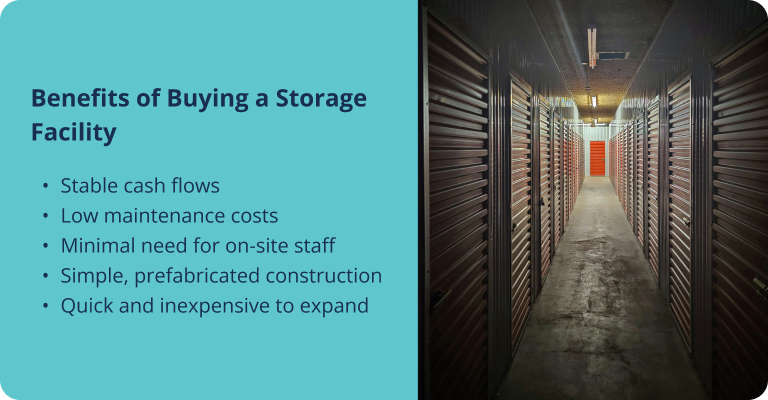
In addition to their expected market growth and recent industry trends, storage facilities offer several benefits that can be appealing to opportunity-driven buyers. Compared to other commercial real estate investments, storage facilities offer higher yields due to their stable cash flows, lower maintenance costs, and minimal requirements for on-site staff. Their simple design and prefabricated construction allows them to be built or expanded relatively quickly and inexpensively, which is also appealing to potential buyers.
So, who is most likely to take advantage of these benefits and buy an existing storage facility? According to recent industry data, 45% of all storage space in the U.S. is owned by large investors and Real Estate Investment Trusts (REITs). This figure suggests that the storage industry is particularly attractive to professional investors and big industry players that are looking to expand their operations. That being said, there is still plenty of room for smaller investors and business owners to enter the market, especially if they can add value to a facility or capitalize on opportunities in under-served or niche markets.
Typical Sales and Valuation Multiples for Storage Businesses
To estimate the value of a storage business, investors will typically consider three main sales and valuation multiples: price per rentable square foot, price per rentable unit, and earnings before interest, taxes, depreciation, and amortization (EBITDA).
Price per Rentable Square Foot
For storage facilities, the typical price per rentable square foot multiple falls between $70-$200 per square foot of enclosed and climate-controlled space. To estimate the value of your facility using this multiple, you can:
Identify the total rentable square footage
Multiply that number by the market multiple ($70-$200)
Adjust the total based on the facility’s condition and occupancy
The resulting figure gives investors a quick snapshot of the facility’s worth relative to similar properties in the market. It’s not an exact value of a facility’s worth, but it helps buyers and sellers gauge a fair price before considering more detailed financial metrics.
Price per Rentable Unit
When considering the price per rentable unit, typical valuation multiples range from $1,000 to $3,000 per unit. For example, when using a valuation multiple of $2,000 per unit, a facility with 100 units would be valued at $200k.
This valuation multiple can be misleading because it values all units equally and doesn’t account for differences in unit size. Using this method, a facility with fewer, larger-sized units would receive a lower valuation than a comparable facility with many smaller-sized units.
EBITDA Multiple
The final multiple that is commonly used for assessing a storage facility’s worth is the EBITDA multiple. Most storage businesses sell at 4x to 7x EBITDA, but this largely depends on the facility’s stable occupancy rate and market risk.
To estimate your facility’s worth using this multiple, you can:
Calculate trailing-12-month EBITDA (earnings before interest, taxes, depreciation, and amortization)
Select a multiple based on the facility’s stable occupancy and market risk
Multiply the 12-month EBITDA by the appropriate multiple
Unlike previous methods that focus on physical metrics, the EBITDA multiple evaluates a facility’s financial health and operational performance. For this reason, investors often look at the EBITDA multiple alongside other multiples to paint a fuller picture of what a storage facility may be worth.
At Dealonomy, we're proud to be the only existing platform that takes businesses from listing to closing with no fees and no strings attached. Receive a free valuation today and see what your business is really worth.
Preparing Your Storage Business for Sale
By taking the appropriate steps when preparing your storage business for sale, you can expedite the sales process, attract more buyers, and ultimately maximize the value of your sale. To do this, you should focus on four key areas: getting your financial house in order, ensuring operational readiness, maintaining legal compliance, and preparing your physical assets and technology.
Preparing Your Finances
Interested buyers will expect clear documentation of your business’s finances. You can finalize a valuation later, but right now, just gather the financial statements and reports most buyers will ask for, including:
Profit loss statements
Accounts receivable and payable
Tax returns
Balance sheets
Cash flow statements
These documents will help you determine your business’s value, negotiate deals, and ensure a smooth handoff.
Ensuring Operational Readiness
Many investors evaluate the amount of effort needed to optimize a business’s operations before acquisition. By ensuring your business’ operations are streamlined and organized, you can ease investors’ concerns and increase the likelihood of a smooth, attractive sale.
The first step in ensuring operational readiness is documenting the day-to-day tasks and standard operational procedures (SOPs) of your facility. When doing this, take note of what your staff members are responsible for, and make sure they can effectively handle these responsibilities.The next step is to improve your facility’s performance. One way to do this is by boosting your occupancy rates through increased marketing and special offers. Facilities with higher occupancy rates are not only more attractive to potential buyers, but they can also increase the value of your sale.

Maintaining Legal Compliance
There are several legal obligations that all business owners must adhere to when preparing their business for sale. For example, they must have a valid business licence, keep accurate financial records, and ensure any debts or liabilities are disclosed or resolved.
When it comes to storage businesses, there are unique legal requirements that business owners should consider before selling their facility. To maintain legal compliance when selling a storage facility, business owners must:
Standardize rental agreements and ensure they comply with state and local laws
Clearly outline policies for late payments, auctions, or abandoned property
Verify the facility is operating within local zoning laws
Keep fire safety systems, alarms, and sprinklers up to code
Maintain proper signage, lighting, and emergency exits
Ensure climate-controlled units meet safety and environmental standards
Maintaining full legal compliance not only helps attract buyers, but it can also save you from dealing with legal ramifications later down the road.
Preparing Your Physical and Technological Assets
The final step in preparing your storage business for sale is making sure your facility’s physical and digital assets are organized, maintained, and fully operational. This enhances your business’s appeal to potential buyers by minimizing the time, effort, and costs that would be required to bring your facility up to full operational standards.
To ensure all of your storage facility's assets are well-maintained and working as they should, create a checklist and perform a thorough property inspection. When creating your checklist, be sure to include:
Storage units
Office buildings
Fencing, gates, and barriers
Security systems, cameras, and alarms
Lighting
HVAC
Sprinklers, fire suppression systems, and smoke detectors
Signs
Parking lots and driveways
Landscaping
Facility maintenance equipment
You should also ensure that your digital assets are working properly, and this can include management systems, billing software, security systems, and any websites or online platforms.
After assessing all of your business’ assets, do any clean-ups, repairs, or updates that will enhance your facilities conditions. Completing these inspections and updates ensures your facility is turnkey for a new owner and positions your business for a smoother, more profitable sale.
When you sell your business with Dealonomy, you’ll never go at it alone. Connect with an expert today and get the guidance you need to navigate the sales process with confidence.
Valuation Methods for Storage Businesses
Most investors buy storage businesses for their ability to generate ongoing income. For this reason, they will often prioritize cash flow over asset value when valuing a self-storage business.
When assessing a storage business’ cash flow, investors will typically look at two metrics: occupancy rates and net operating income.
Using Occupancy Rates to Determine a Storage Business’ Value
Storage facilities that have consistently high occupancy rates represent safer investments for potential investors, as they have predictable cash flow and higher revenue potential. To determine a storage business’ value, investors will often look at both the physical and economic occupancy rates of the facility.
Physical occupancy rates refer to the percentage of units that are currently being rented, and it can be found by dividing the total number of available units by the total number of rented units. For example, if a storage facility has 100 total units and 70 of them are currently being rented, then it would have a physical occupancy rate of 70%.
Economic occupancy rates represent the percentage of units that are rented at full asking price. This number accounts for units rented at a discount, and it can be found by dividing the potential revenue of rented units by the actual revenue of rented units. For example, if a storage facility has 100 total units, with 70 rented at full price and 30 rented at half price, its economic occupancy rate would be 85%.
Using NOI to Determine a Storage Business’ Value
Net operating income (NOI) is a metric used to analyze the profitability of income-generating real estate. It measures the cash generation of a business before financing and taxes, and it can be found by subtracting a business’ operating expenses from its gross annual revenue. To determine a storage facility’s gross annual revenue, multiply the total rentable square feet by the occupancy rate and rent price per square foot, then multiply that total by 12 (for 12 months in a year). Subtract your business’ yearly operating expenses to get the NOI.
Many investors will also factor in the market’s cap rate, which is a figure that is influenced by market conditions, investor expectations, and lender requirements. They do this by dividing the NOI by the market cap rate, and the resulting total reflects a storage facility’s estimated value.
Benefits of Receiving a Professional Valuation
It’s important to mention that occupancy rates and NOI values are two pieces of a much larger puzzle. When used alongside sales multiples and other valuation methods, they can be helpful at giving buyers and sellers a good starting point. However, to develop an accurate valuation for your business, there are several additional factors that should be considered. Some of these factors include:
Local competition
Facility type and size
Unit type and size
Unique value drivers
Facility accessibility and visibility
Marketing efforts and online presence
Business owners who attempt to value their storage facility on their own run the risks of valuing their business too high and scaring away potential buyers, or valuing it too low and missing out on maximizing the value of their sale. For these reasons, many business owners turn to trusted experts to guide them through the valuation process.
With Dealonomy, you don’t need to rely on costly brokers and advisors to get an accurate valuation for your business. Our platform and services are 100% free for sellers, so you can get an accurate business valuation from your own dedicated team of expert advisors, all at no cost and with no hidden strings attached.
Marketing Your Storage Business
Marketing a storage business typically involves creating a marketing package, identifying target buyers, and listing your business on the appropriate marketing channels. With Dealonomy’s platform, this entire process becomes fast, frictionless, and fully supported.
Creating a Marketing Package
When it comes time to sell a storage facility, a well-prepared marketing package can make all the difference. Think of it as your facility’s story, carefully packaged to capture a buyer’s attention and show them why your business is worth their investment.
A strong marketing package typically includes:
Strategic positioning – a clear explanation of where your business fits in the market and how it’s poised for growth
Outreach methods – the mix of digital platforms, broker networks, and industry channels that will put your opportunity in front of the right buyers
Buyer profiles – insights into the types of investors most likely to be interested, whether that’s individuals building their first portfolio or established storage operators expanding their footprint
Supporting materials – everything from occupancy data and revenue trends to photos, maps, and details about facility upgrades
With Dealonomy’s platform, you gain access to a personal Dealroom where you can conveniently create and manage your marketing package. You’ll also receive expert guidance from M&A professionals who will help you paint a compelling picture of why acquiring your storage facility is a smart, profitable move.

Identifying Your Target Buyers
Your marketing package should also serve as a roadmap for connecting with the right type of buyer. For many storage business owners, this could mean larger operators or REITs (Real Estate Investment Trusts), since they currently control nearly half of all self-storage space in the U.S. and are actively expanding their portfolios.
Many smaller buyers, such as local entrepreneurs, regional operators, or first-time investors, are actively looking for opportunities, too. While they may not have the same scale as institutional buyers, smaller investors tend to be more flexible in negotiations, more invested in the day-to-day success of the business, and more willing to pay a premium for a property that aligns with their long-term goals.
When you sell your storage facility on Dealonomy’s platform, your business is marketed directly to a broad network of both large-scale operators and independent investors. Our team of experts will help you decide which buyer is right for you and your business goals.
Why Should You List Your Storage Business on Dealonomy?
When it comes to selling a storage facility, visibility is everything. Today, most serious buyers begin their search online or with a broker, and specialized acquisition platforms are one of the fastest ways to get in front of them.
Dealonomy is designed specifically for connecting quality businesses with well-qualified buyers. Unlike general listing sites, it’s built around the idea of “good deals only,” meaning the buyers on the platform are already vetted and serious about making acquisitions. This is a major advantage for storage business owners, as you’re not wasting time fielding lowball offers or talking to people who aren’t ready to buy.
By listing your facility on Dealonomy, your opportunity is distributed directly to a network of motivated buyers who are actively looking for properties like yours. It takes the guesswork out of marketing by ensuring your business is seen by the right audience without having to launch an extensive campaign on your own.
For storage business owners, listing your business on Dealonomy can mean faster interest, more competitive offers, and a smoother path to closing.
Navigating the Storage Business Sales Process
When selling your storage business, you’ll go through a formal sales process that keeps the transaction moving smoothly from start to finish. Dealnomy breaks the sales process down into 4 steps:
Preparation (1-2 Months)
Marketing the Business (3 Months)
Negotiation and Due Diligence (3 Months)
Closing and Transition (1-3 Months)
Dealnomy’s sales process creates transparency and fairness for both the buyer and seller. This gives both parties peace of mind throughout the process and protects them from bad business deals.
Preparing Your Storage Business for Market
Preparing your storage business to hit the market is the first step in the sales process. During this phase, you’ll make sure all financial documents, contracts, and tenant files are well-organized and easily transferable. You should also develop an accurate business valuation and create an effective exit strategy at this time.
Dealnomy simplifies this phase of the sales process by providing you with a free business valuation and an expert consultation to help you plan the best exit strategy. Our experts will also make sure you and your business are fully prepared for a successful sale.
Marketing Your Storage Business
The second phase of the sales process is marketing your business. During this phase, your storage business is listed on the appropriate channels to attract the perfect buyers.
When you sell your storage business on Dealonomy’s platform, your listing is immediately positioned in front of vetted, highly qualified investors. Premium buyers are notified about your opportunity 10 days before it’s released to the broader network, giving your facility early exposure to serious buyers who are actively seeking deals.
Dealonomy’s targeted approach ensures your business gets maximum visibility with the right audience, all while saving you time and effort in the process.
Negotiation and Due Diligence
Once your storage business is listed on the market, you will begin to receive letters of intent (LOIs) from interested buyers. From here, the sales process moves into the negotiation and due diligence phase, where terms are finalized and details are carefully reviewed.
During this phase, interested buyers will carefully review your facility’s financials, occupancy rates, lease agreements, and any other relevant operational data. They may also tour the property, inspect equipment, and verify that all systems are functioning as described. This is also the stage where buyers and sellers negotiate terms, including price, contingencies, and closing timelines, to ensure both parties reach a mutually agreeable deal.
With Dealonomy, you’ll gain expert advice and guidance throughout the entire negotiation and due diligence process. We’ll help you review and respond to offers, structure terms that protect your interests, and ensure all financial and operational information is presented clearly.
Closing and Transition
Once negotiations and due diligence has been successfully completed, it’s time to close the deal. During the closing and transition phase, you will complete all necessary documentation to ensure a smooth handover and, of course, receive payment for your business.
When you sell your storage business with Dealonomy, you’ll get a dedicated team of experts to guide you through the transition process. We also ensure you receive the maximum value of your sale with free valuations, 0% commission fees, and no closing costs.
Challenges of Selling a Storage Business
While every business sale comes with its challenges, there are a few challenges that are unique to storage businesses. When left unaddressed, they can complicate the sales process and put your business deal in jeopardy.
That being said, business owners who address these challenges early can streamline the sales process, maximize the value of their facility, and ensure a smoother, more successful transaction.
Poor Facility Conditions
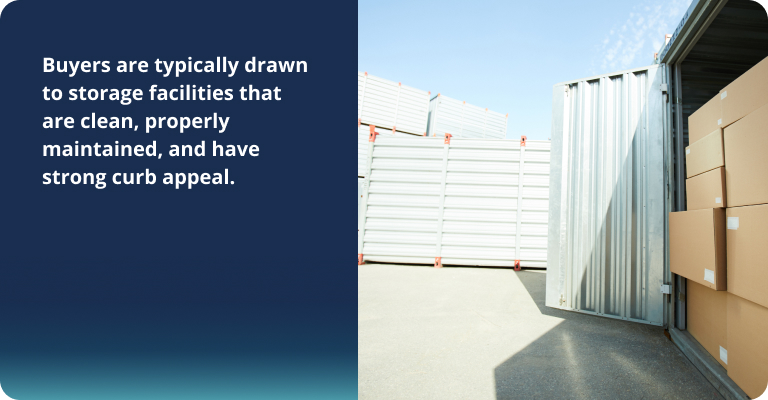
Buyers are typically drawn to storage facilities that are clean, properly maintained, and have strong curb appeal. If they discover cracked concrete, dirty units, or broken security features, it can create doubts about the overall management of the facility and may lower their perceived value of the business.
To create a strong first impression and attract serious buyers, you should perform a facility inspection and clean or repair anything that could reduce its appeal. Cleaning and repairing your facility is a relatively small investment that could save you a lot of time and money during the sales process.
Incomplete Tenant Lease Transfers
As your storage business exchanges hands, so do your tenant lease contracts. Incomplete or inconsistent tenant lease contracts can create legal and operational headaches for the new owner, and this can quickly turn them away from your storage business.
To overcome this challenge, you should standardize all tenant contracts and ensure they are up to date. Make sure all contracts are well documented and organized, and implement a digital filing system if you can. Buyers are more attracted to facilities that are easy to manage right from the start.
Lack of Seller Transparency
Failing to be transparent about your facility’s condition, financials, or motivation for selling can create doubt and lead buyers to suspect hidden risks. This lack of trust can slow down negotiations, reduce the number of serious offers you receive, or even cause a deal to fall through altogether.
If you’re worried that certain aspects of your storage business could affect the sale, then you should take the time and effort to address them, rather than cover them up. Professional buyers are cautious and thorough, and during due diligence they will quickly uncover any inconsistencies or hidden issues.
Sell Your Storage Business the Modern Way with Dealonomy
Selling your storage business is one of the biggest decisions you’ll make, and it’s not something you want to leave to chance. To get the full value for your business and ensure a smooth transaction from start to finish, you’ll need professional help.
The problem with seeking professional help is that traditional brokers and advisors can charge steep commissions, often taking 5%–15% of your sale price. On top of that, their process can be slow and outdated, leaving you with fewer qualified buyers and unnecessary delays.
Dealonomy recognizes the challenges business owners face with traditional brokers and offers a smarter, modern alternative. Our platform combines advanced technology with personalized support to connect you directly with vetted, qualified buyers. Unlike traditional brokers, we charge 0% commission and no success fees, so you keep the full value of your storage business.
With Dealonomy, you can get more money for your storage business, reach serious buyers faster, and move through the sales process with confidence.
FAQs
What Are the Fees for Selling My Storage Business?
Dealonomy’s platform and services are 100% free for sellers, which is unique in the industry. Unlike traditional brokers who charge 5%–15% in commissions, we never take a cut of your sale. Instead, we focus entirely on helping you maximize your outcome with free professional valuations, no commission or success fees, and dedicated support from a team of experts.
From preparing your business for the market to connecting you with serious, qualified buyers, Dealonomy gives you all the benefits of expert guidance without the high costs.
How Do I Attract Serious Buyers for My Storage Business?
At Dealonomy, we leverage our network of vetted, well-qualified buyers to help you find the perfect buyer for your business. That being said, you should ensure your finances are up to date and accurate, your facility is clean and well-maintained, and your transition plan is thorough and organized to expedite the sales process and attract potential buyers.
How Do I Value My Storage Business?
Valuing a storage facility isn’t as simple as putting a price tag on the property — investors look at multiple factors to determine its true worth. The three most common methods are:
Price per rentable square foot (typically $70–$200 per sq. ft. of climate-controlled space)
Price per rentable unit (usually $1,000–$3,000 per unit, though this can be skewed by unit size differences)
EBITDA multiple (generally 4x–7x your trailing 12-month EBITDA, depending on occupancy stability and market risk)
In addition to these sales multiples, buyers also weigh your occupancy rates and net operating income (NOI) to gauge the strength and stability of your cash flow.
With Dealonomy, business owners gain access to free professional valuations that combine these methods with market insights, giving you a clear, data-driven picture of what your facility is truly worth. This ensures your storage business is priced competitively to attract qualified buyers while maximizing your return.
Who Is the Typical Buyer of Storage Businesses?
The majority of buyers today are large investors and Real Estate Investment Trusts (REITs), who now own about 45% of all storage space in the U.S. At the same time, there is still strong demand from smaller investors and independent business owners who see opportunities in local markets, underserved communities, or by improving underperforming facilities.
With Dealonomy, your listing is placed in front of both large institutional buyers and serious smaller investors. Because every buyer on the platform is vetted and qualified, you can be confident your business is being seen by the right audience — whether that’s a major REIT or a motivated individual buyer.
Sell Your Storage Business With Dealonomy
Selling your business is simpler and more efficient with Dealonomy’s frictionless platform. Traditional brokers often charge steep commissions and success fees, but with Dealonomy, you keep the full value of your sale.
Sellers enjoy unmatched benefits, including free valuations, 0% commission fees and a 90-day guarantee—if you don’t receive a serious LOI within 90 days, we pay you $10,000.
Our proprietary selling software streamlines the entire process, while a dedicated team of experts guides you from start to finish, ensuring your transaction is smooth, transparent, and profitable.
List your business and get access to experienced advisors at no cost. Request a free business valuation, and let’s find you a buyer.
Share this post