The Complete Guide to Selling a Liquor Store in 2025
14 min read
Share this post


Liquor stores have a unique place in the economy. Some people call them recession-proof. It is true that they follow different growth trends than other sectors.
When belts tighten, liquor stores suffer far less than bars and restaurants. This steadiness can make liquor stores an attractive option for potential business buyers.
However, shifting trends in consumer preferences, a decrease in overall alcohol consumption in America, and recent tariffs all add a level of turbidity that can throw a wrench in your plans to sell your liquor business.
Whether it’s simply time to retire or you want to explore new business opportunities, selling your liquor store takes some dedicated planning. This guide was made to let you know how simple and seamless selling your liquor store business through Dealonomy can be.
Dealonomy offers a platform to sell your business without the headaches, while our team provides expertise and guidance throughout the whole process.
Understanding the Liquor Store Market
Alcohol has been a part of cultures around the world for millennia, and that isn’t changing anytime soon. Modern consumer trends seem to be pushing and pulling against each other, but overall, they create a positive growth for liquor stores in 2025 and beyond.
Current Market Conditions
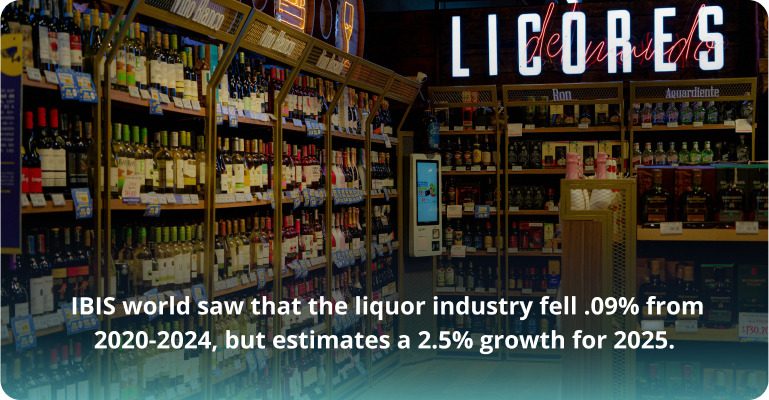
As mentioned before, the liquor retail industry has seen far less dramatic swings than other sectors. IBIS world saw that the liquor industry fell .09% from 2020-2024, but estimates a 2.5% growth for 2025.
One positive factor for liquor stores is that consumers are opting to drink at home rather than at bars or restaurants. While those businesses have seen a decrease in sales, the liquor retail market hasn’t suffered as much.
On the other side of things are fewer restraints on retail liquor licenses. Many states are allowing grocery stores to sell beer, liquor, and wine where they haven’t been allowed to before. This means more competition for small liquor stores.
Industry Trends
There are a few different trends that are changing the way liquor stores need to operate, and will continue to do so for several years.
While alcohol itself is relatively recession-proof, the kinds of beverages that liquor store owners need to carry is changing.
The alcohol that consumers are drinking has shifted in the last five years. According to Statista, spirits and liquor have overtaken beer as the #1 alcohol of choice for Americans. Though prices have gone up across the board for alcoholic beverages, a culture shift has emerged—more people are opting for cocktails. Ready-to-drink (RTD) cocktails are becoming more and more popular. Forbes estimates the RTD market will continue to grow for the next several years.
These market trends aren’t just driven by beverage preferences, but how much people are drinking. It may seem contradictory to the steadiness of the liquor market, but fewer people are drinking alcohol than ever. One huge factor is that consumers are now more health-conscious about alcohol. They’re opting for lighter liquor options like many RTDs.
Overall, consumers are more deliberate with their drinking choices. Liquor store owners need to stay tuned in to the craft of alcohol innovation, rather than just provide as many options as possible.
Buyer Demand
Not only is the liquor store market stable, but it’s easy for owners to attract return customers. Compound that with high profit margins, liquor stores can be an extremely attractive business for entrepreneurs to buy.
Liquor store buyers are looking for something they can own independently, with few startup costs and simple daily operations. Most liquor stores are small and independently-owned, and owners have a lot of control over how much they make.
The average liquor store profit margins are around 20%-30%. Owners can make this higher depending on the markups they choose to implement. Often, on higher-end products and wine, markups can be upwards of 50%, which is still far lower than the standard 200% for wine in restaurants.
Typical Multiples
Multiples are one of the most common ways to get a snapshot of the value of a liquor store before selling. They compare estimated or average values of a business to the actual earnings of a specific business. There are two types of multiples: Earnings and revenues.
Earning multiples use the seller’s discretionary spending against the value of the business. For liquor stores, the average earnings multiple is 3.17.
Revenue multiples estimate a business value based on total sales. For liquor stores, this can range anywhere from .27 to .77, depending on several factors, including whether a business is being listed or not.
Preparing Your Liquor Store for Sale
In a nutshell, preparing your liquor store business for sale involves getting all financial and legal documents sorted. Buyers prefer to purchase a business that is well-run and organized. Here are a few things to consider when preparing to sell your liquor store.
Getting Your Financial House in Order
The valuation and sale of your liquor store require extensive documentation. This includes:
Profit loss statements
Balance sheets
Cash flow statements
Tax returns
Accounts receivable and payable
This will help you find the true value of your business and help the buyer feel more comfortable with the purchase.
Operational Readiness
Alcohol sales are heavily regulated across the US. The Alcohol and Tobacco Tax and Trade Bureau requires paperwork from the new owners after the sale, but also some housekeeping from the previous owners during their tenure.
Have easy-to-access records of all alcohol that enters your store, including any reports of broken or unsellable items. An inventory valuation may not always be necessary, but it’s always a good idea to have that prepared for buyers.
Of course, make sure your liquor license is up-to-date and valid in accordance with your state laws. Many states require a transfer of ownership application that both the owner and buyer will have to be involved with.
Physical Assets and Technology
The actual physical space and assets of a liquor store aren’t worth much, but the inventory is enormously valuable. One of the best things you can do to prepare for selling a liquor store is to make sure your security measures are up to snuff. Update locks, make sure security cameras cover the entire store, and do an audit of broken security equipment.
Buyers don’t want a “fixer-upper.” In addition to updating security measures, ensure that all equipment is ready to go, including coolers.
Valuation Methods for Liquor Stores
Determining how much to sell your business for is a delicate dance of measuring earnings against costs. Different valuation methods may give you different numbers; however, they should be in the same ballpark and give you solid guidelines about how to list your business.
Primary Valuation Approaches
The multiples mentioned earlier are part of the market valuation approach. This is one of the more common valuation methods that compares an individual business against market averages.
An income valuation approach uses earnings projections to value a liquor store. There are several different methods of income valuation, but they follow the same idea that past earnings will correlate with future earnings and, therefore, the business value.
Industry-Specific Valuation Factors
Other businesses may use more of an asset-based valuation, but liquor stores generally rely on rotating inventory to provide value. Therefore, the market or income valuation is more appropriate.
Like most businesses, the value of the business is driven in part by location. Foot traffic and rent are huge factors in determining the value of a business. For liquor stores, the value may be affected by local liquor laws. Liquor stores may be valued more in places where grocery stores can’t sell alcohol or specific drinks.
Professional Valuation Benefits
Though you may have all of the resources to find the value of your business, it can be a lot of work. Professionals, like the team at Dealonomy, have the expertise to aggregate the data from multiple valuations to find the best asking price for your liquor store business.
Marketing Your Liquor Store Business
Even if your liquor store is in prime condition and earning well, you still need to market it to potential buyers.
Target the Right Buyers
In your listings, make sure your potential buyers are confident in the success of the business. Location not only affects the value of your business but it shows opportunities for growth. Talk about the amount of foot traffic, returning customers, and desirability of the neighborhood.
There are over 45,000 liquor stores in the US, according to IBISWorld, most of which are independently owned. Buyers are likely going to be local, and they may not have owned a liquor store before. In your listing or during negotiations, you can talk about how the liquor store market will remain stable throughout the ebbs and flows of the economy.
List Your Liquor Store Business with Dealonomy
Since buying and selling a business can be complicated with a lot of money at stake, it’s best to use specialized channels to market to potential buyers.
Dealonomy not only is a marketplace for liquor store owners to list their business to sell, but we also have a team of experts that can help you valuate your business, ensure you have everything you need to list, identify potential buyers, and negotiate contracts.
We prioritize direct buyer connections and only facilitate good deals for both the buyer and seller. We take 0% commission from sellers, so you get the most from your hard work running your business.

Navigating the Sales Process
As liquor store owners know, some of the required steps in getting a business up and running can take more time than you want them to. Even if the process is seamless, it doesn’t quite happen overnight.
One of the biggest hurdles in selling a liquor store is transferring the liquor license. In most states, this can take six weeks to a year.
Though that process may be out of your hands, you need to remember that there are some steps you need to get done early so you don’t hold up the acquisition. Conduct or stay updated on inventory. Your buyer will want to know exactly what they’re acquiring as soon as they get the keys.
All in all, you want to expect six months to a year to sell your liquor store.
The 4-Phase Timeline
Every business sold on Dealonomy follows the 4-phase process:
Preparation (1-2 Months)
Marketing the Business (3 Months)
Negotiation and Due Diligence (3 Months)
Closing and Transition (1-3 Months)
The preparation step involves everything you need to get your ducks in a row before you officially list—things like financial documents, storefront updates, and inventory. This also includes a free valuation from Dealonomy that will determine marketing and next steps.
During the marketing phase, we connect with potential buyers. We alert premium buyers before publishing the listing.
We’ll start the negotiation process after we receive a letter of intent from a buyer. We only accept good deals, so we use this time to ensure that everyone walks away happy. This can involve price adjustments and due diligence evaluations from the buyer.
Finally, we’ll guide you through the closing process. You and your buyer will sign all legal documents to transfer ownership. Your Dealonomy deal team will be there the entire way to help ensure the transition is seamless. We’ll facilitate a plan to make the transition complete and easy.
Common Challenges & Solutions
Inventory Disputes
Once again, the main value of a liquor store is its inventory. It factors into the buyer’s offer since it determines what they can offer to customers right off the bat.
Inventory disputes between the buyer and seller can hold up the acquisition process. The buyer does have every right to ask for a re-do or a third party to count if they feel that the seller declared more inventory than what’s in the store.
It’s one reason regular inventory counts are so important, and it’s especially smart to do them more often when you’re trying to sell your business.
Changing Liquor Laws
It’s difficult to sell a business when there’s an impending change that can negatively affect sales. If you’re in an area where grocery stores are now allowed to sell more alcoholic products than before, you may notice potential buyers are backing away.
All liquor law or licence changes can be a challenge to sell your liquor store. However, you can quell any fears in a few ways.
For one, you can implement robust customer rewards programs if you don’t already have one. People are more likely to come back to your store if they have an established relationship with the store and have a reason to purchase alcohol from your store.
Another way is to lean into a niche that the grocery stores can’t fill. Whether that’s high-quality or a wide selection of wine, a focus on local liquors and spirits, or offering a number of mocktail options, you can carve out a space in the market for your store to thrive.
Valuation Concerns
One of the reasons that Dealonomy offers free valuation is so that both you and the buyer feel confident in the price of your business. Though negotiations are common in business sales, you don’t want the seller to guffaw at the number on the listing. Unfortunately, it’s a common pitfall of business owners to either do their own valuation or guess at the business value. Either way, the quote will likely not be completely accurate or equitable.
The Dealonomy team can ensure that the price is fair for all parties. This not only keeps the timeline shorter, but it also attracts better buyers.
Economic Downturns
Though liquor stores are relatively safe from a lot of economic concerns, potential buyers may not know that or are simply nervous about investing that much money.
Part of marketing your business for sale should include the benefits of operating a liquor store, especially yours.
A returning customer base can once again help mitigate buyer concerns and secure cash flow. Reward programs make a low-cost luxury like alcohol even more low-cost, or, depending on the rewards, can help people afford a little more luxury.

Sell Your Liquor Store For Free With Dealonomy
You’ve put in blood, sweat, and tears to run your liquor store. Let Dealonomy do the heavy lifting when it comes to selling it.
Why choose Dealonomy to sell your liquor store?
It costs sellers $0 to list their business
If you don’t get a fair offer in 90 days, we’ll pay you $10,000
We use a high-tech, high-touch approach for open communication and a seamless sales process
Our deal team has industry experts who have experience in facilitating liquor store business sales. We’ll not only do the work to find the right buyer, but we’ll provide tools and education that will help you before, during, and after you sell. Request a free business valuation today.
FAQs
How long will it take to sell my liquor store?
On average, it will take six months to a year to sell your liquor store. This can vary depending on liquor license transfer timelines, how well you prepare your business for sale, and current market conditions.
What do I need to do to get the new owner’s name on the liquor license?
The process for transferring ownership of a liquor license can vary by state, but it usually will be up to the new owner. They’ll need to apply for a transfer through their local and state authorities, and also submit a TTB F 5630.5d form through the Alcohol and Tobacco Tax and Trade Bureau.
Can I sell my liquor store online?
Yes you can! Dealonomy is an online marketplace where sellers can list their businesses and buyers can look for their next opportunity. Sign up today to get a free business valuation and learn more about listing your business through Dealonomy.
How do I get the most value for my liquor store?
To increase how much your business is worth, make updates to your security system, create loyalty programs to lock in return customers and increase revenue, and make sure your inventory is current and reflects consumer trends.
How do I attract serious buyers?
Make sure your liquor license is up to date and you’re in good standing with local liquor authorities, have detailed inventory lists, and offer a competitive asking price.
List Your Liquor Store for Free
Selling your liquor store with Dealonomy is simple, frictionless, and free.
Our team of experts will not only guide you through the whole process, we’ll facilitate negotiations and vet qualified buyers.
Why choose Dealonomy over a traditional brokerage model?
Get an offer in your valuation range in 90 days or we’ll pay you $10,000
We take no commission from any sellers
We’ll market your business to serious buyers
Our team of experts and proprietary software make the entire sale process seamless. Sign up, get a free business valuation, and tap into a pool of experts and resources dedicated to getting you the best deal possible for your liquor store.
Share this post